
How to Identify Your BSA
First of all, a word of caution for anybody buying a machine, particularly if it does not have any documentation or proof of origin, BUY WITH CAUTION. If it has a V5C, NOVA or other documents, check that the frame and engine numbers on them are exactly the same as those stamped on the bike. Be wary of engine or frame numbers which appear to have been altered – this can cause problems with licencing authorities. Mistakes can later prove very expensive.
Remember: Buyer beware.
NOTE: This is just a guide and will fit most situations, but frames were legitimately re stamped by dealers if the original was damaged and a replacement fitted. These could be stamped anywhere and often were not stamped at all!
Frame and engine number are always stamped; any raised numbers are casting numbers.
Up until 1966 it is rare for the engine and frame number to be identical (except for special orders, such as AA, GPO Bantams and MoD bikes). On some models the frame is shared by several engine types and the frame codes normally start with the smallest model (e.g. all A7/A10 series models have A7 frame prefixes - with the exception of the Rocket Gold Star and Super Flash).
Engine Markings
Engine numbers are easier to find and are usually on the crank case by the base of the engine cylinder on the primary (left hand) side.
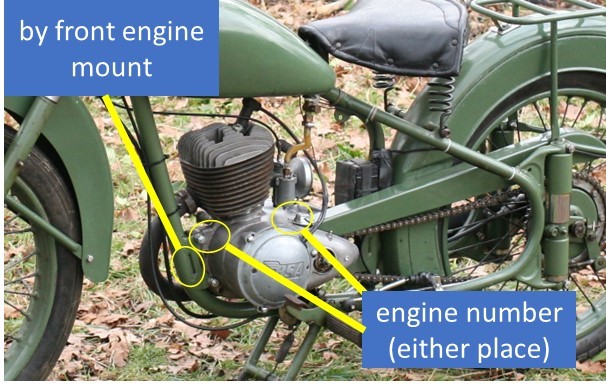
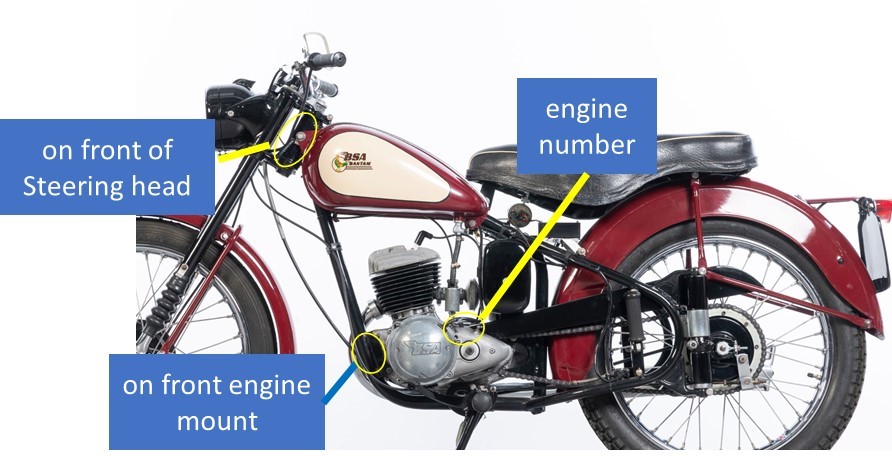
Exceptions are the Bantams which could be stamped on the left side front mounting point or on the left side top surface behind the crankcase mouth / above the gearbox.
Pre-war Motorcycles Markings
This varies from model to model, but the frame is usually marked on one of the following:
- by the front seat mount
- by the steering head
- by or on the front engine mount
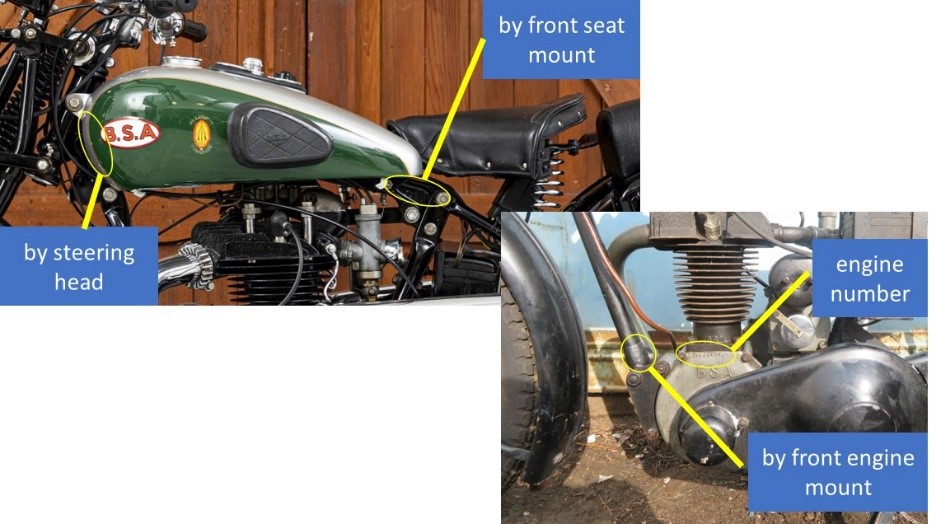
Up until 1929, engines and frame markings were either just a number or were a single letter followed by a serial number (depending on model and year). For 1930 the markings were two letters followed by a serial number, with the first letter being an “X” (e.g. XM ****/ XR **** / XV ****** / etc.). For 1931 - 1936 the markings were a single letter with a number (1 to 15 or 150 – to indicate model type) followed by a serial number. The first letter indicates the year (Y – 1931 / Z – 1932 / A – 1933 / B – 1934 / E – 1935 / D – 1936). For 1937 through to Wartime Machines (1945) the markings were a letter (indicating year) plus Model designation (letter plus number) followed by a serial number. The year letters were: H – 1937 / J – 1938 / K – 1939 / W – 1940-45. For example, a 1938 model B24 would be JB24 ****. Note: There are some 1939 models marked KJ (plus model), which appear to be a cross over from 1938 models.
The following links take you to detailed lists of engine and frame number by year and model:
- All models from 1921 until 1930
- All models from 1931 until 1945
Post War and 1950's Engine and Frame Markings
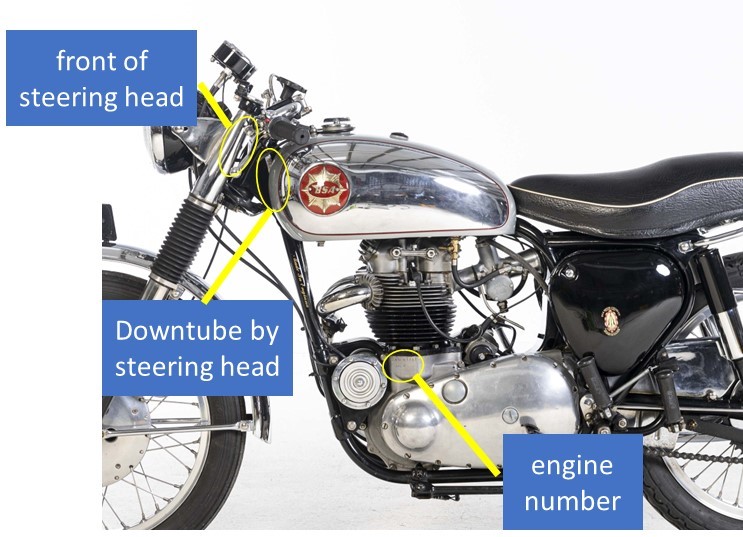
Typically, the frame is marked on the front down tube below or in front of the petrol tank. On some models it is stamped on the front of the steering head.
For some Bantams the frame number is between the front engine mounting plate. These can be faint and small. The engine number is either near the front engine mount or on top of the casing behind the cylinder
On later Bantams the frame number is on the front of the steering head or left-hand side of the engine mounting plate. Note: these plates sometimes break and re-welding obliterates the stamping.
The post war civilian model markings were initially a variation of the prewar scheme, with a letter (indicating model year) plus Model designation (letter plus number) followed by a serial number. The initial year letters were: X – 1945/46/47 / Y - 1948 / Z – 1949-52. However, from around 1951 the first ("year") letter was not always the same across the various models in a given year, but changed as model versions changed. For example, the new A7 engine in 1951 was prefixed AA7, whereas the (existing) A10 engine was prefixed ZA10. By 1956 there were first prefix letters of B, C, D and E all being used on various models at various times, so it’s best to refer to the detailed lists provided by the links which follow each section.
The following link will take you to detailed list of engine and frame number by year and model:
- All models from 1945 until 1950
- All models from 1951 until 1960
1960-65 Frame Markings
Frame markings are by the steering head reinforcing plate or front down tube on left hand side.
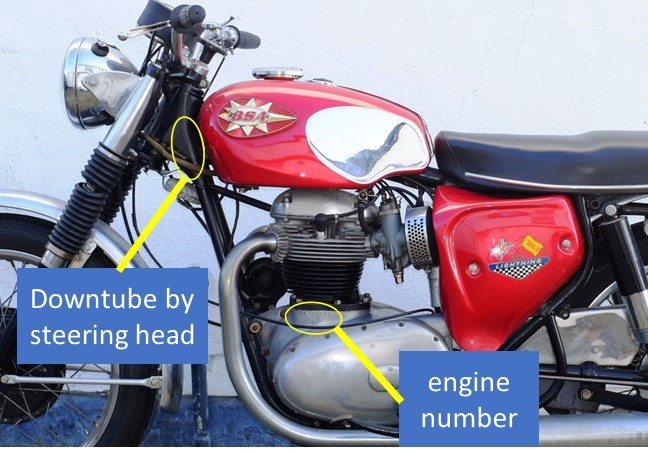
NOTE: For Bantams see images for 1950's above.
As the 1950’s models were phased out, the use of a first prefix letter on the engine / frame to indicate year or model version was removed and just the model designation was used (e.g. C15 / A65 / etc.). Where variants existed, then a suffix (1-3 letters) was used after the model designation to indicate a change of specification (so the likes of C15T / C15S / A65L / A65T / A50AP / etc. were used). It’s best to refer to the detailed lists provided by the links which follow each section.
The following link will take you to detailed list of engine and frame number by year and model:
- All models from 1961 until Factory Closure in 1973
1965-70 Frame Markings
Frame markings are usually on the front engine mounting lug.
Note: from approx. 1966 onwards the engine and frame numbers, as they left the factory, were the same.
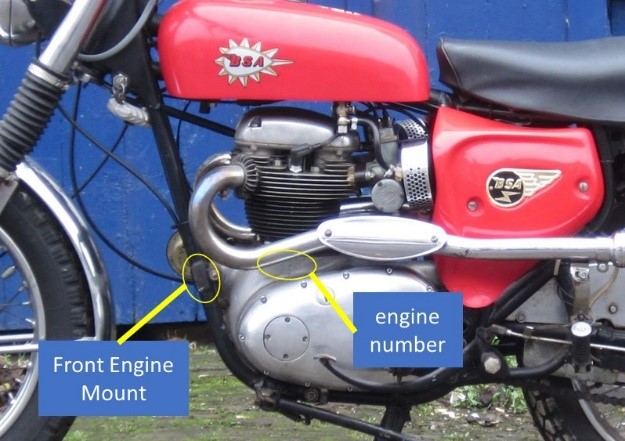
NOTE: For Bantams see images for 1950's above.
For 1969 onwards the engine and frame numbers include two letters to show month and year of manufacture. See section below for details.
The following link will take you to detailed list of engine and frame number by year and model:
- All models from 1961 until Factory Closure in 1973
1971 Oil In Frame Models Engine and Frame Markings
Twins and triples are marked on the steering head tube (typically on the left side). Some of the oil in frame B-series (e.g. B25) frames are stamped on the prop stand bracket.
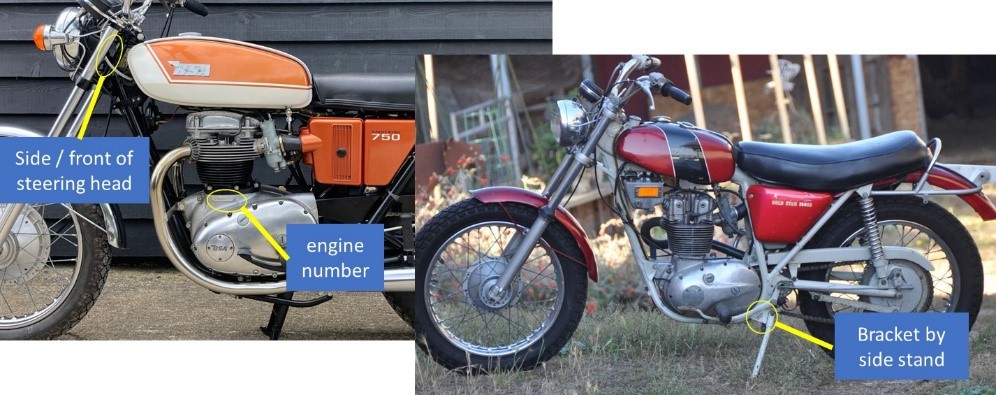
For 1969 onwards the engine and frame numbers include two letters to show month and year of manufacture. See section below for details.
The following link will take you to detailed list of engine and frame number by year and model:
- All models from 1961 until Factory Closure in 1973
Identifying Engine and Frame Numbers, 1969 season onwards.
Owners with late model BSA's can easily identify the month and year of their machine, as the factory adopted a dating system for frame and engine numbers for the 1969 season models onwards. As with all previous BSA seasons the model year started after the factory shutdown in July so that 1969 models were those made from August/September 1968, through to July/August 1969. They would however have some machines in stock, so it is possible that a July/August model may be to either the previous or the next year's specification.
The code consisted of three parts, the first as two letters giving month and year respectively, the second was a five digit number and the third a model code. The engine and frame received the same markings. After dating and identifying many thousands of BSA's we have found that often a bike was built or shipped outside the dates given by the lettering system so this should only be used as a rough guide to the year and month of your machine.
The date letters are as follows:
| 1st Letter | 2nd Letter |
|---|---|
| A – January | C – 1969 Model |
| B – February | D – 1970 Model |
| C – March | E – 1971 Model |
| D – April | G – 1972 Model |
| E – May | H – 1973 Model |
| G – June | J – 1974 Model |
| H – July | |
| J – August | |
| K – September | |
| N – October | |
| P – November | |
| X – December |
NOTE: To avoid confusion‘‘F’, ‘I’, ‘O’, and ‘L’ were not used, although it is easy to confuse letters ‘C’ and `G’
Dating Certificate (For Display / Information only - for registration refer to Registration Overview )
We can provide a dating certificate for your machine from our records. To obtain one you need to contact to the Machine Dating Officer - full contact details on the Machine Certificate Request Form.
You will require rubbings or photographs of the frame and engine numbers and photographs showing the machine.
Complete the application form and tick the "For info only" box - see Machine Certificate Request Form.
Updated 07/2026